Neural Quantum Spectral Operator Learning
for Solving Partial Differential Equations

NeurIPS 2026 · Poster

Chanyoung Kim1, Myeonghwan Seong2, Yujin Kim2, Daniel K. Park2,3,4,†, Youngjoon Hong5,†
1Interdisciplinary Program in Artificial Intelligence, Seoul National University 2Department of Statistics and Data Science, Yonsei University 3Department of Applied Statistics, Yonsei University 4Department of Quantum Information, Yonsei University 5Department of Mathematical Sciences, Seoul National University
†Corresponding authors
Email: chanyoung.kim@snu.ac.kr, {europa0306, k.yujin2228, dkd.park}@yonsei.ac.kr, hongyj@snu.ac.kr

TL;DR: A hybrid quantum–classical framework for unsupervised PDE solving via spectral operator learning.
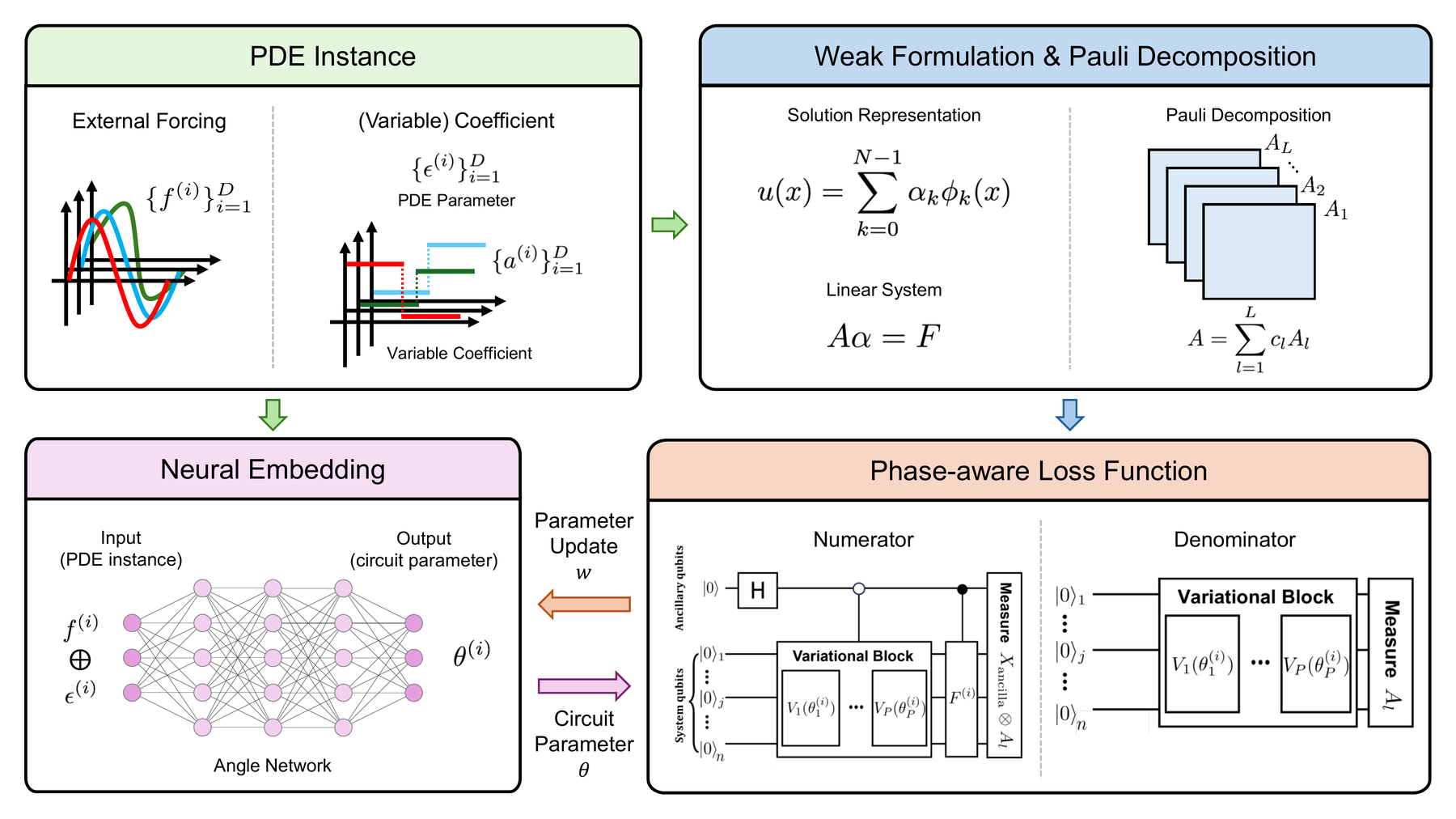
Overview of the NVQLS training procedure.
Overview of NVQLS. An angle network encodes a batch of PDE instances into quantum circuit parameters $\theta$, while a loss function based on quantum state overlap minimizes weak-form residuals. Each component of the loss is evaluated through quantum subroutines with measurement grouping.

Abstract

Partial differential equations (PDEs) are central to modeling physical and engineering systems, but repeatedly solving parametric PDEs remains computationally expensive. Operator learning enables fast surrogate inference, yet typically requires large input–output paired datasets generated by costly high-fidelity PDE solvers. Unsupervised operator learning frameworks alleviate data dependency but remain hindered by computational bottlenecks. To address this limitation, we propose the Neural Variational Quantum Linear Solver (NVQLS), the first hybrid quantum–classical operator learning framework leveraging the Legendre–Galerkin weak formulation. We first resolve the sign ambiguity in VQLS energy minimization, preventing erroneous solution representations. Furthermore, we introduce a neural embedding, a novel encoding scheme that maps varying forcings and PDE coefficients into parameterized quantum circuit representations. These structural innovations improve per-iteration computational cost and memory scaling under suitable assumptions, while achieving superior accuracy compared to classical baselines. Validations on 1D, 2D and 3D parametric PDEs under diverse boundary conditions demonstrate NVQLS’s capability to simultaneously process varying inputs, offering a scalable unsupervised approach to quantum-enhanced operator learning.

Method

Phase-aware overlap cost

With a Legendre–Galerkin weak formulation, a PDE reduces to a linear system $A\alpha = F$ for the spectral coefficients $\alpha$ of its solution. The standard VQLS objective determines the solution state only up to a global phase, which can produce sign-flipped (reflected) PDE solutions. NVQLS instead uses the real part of the quantum state overlap:

$$\mathcal{L}_{\mathrm{NVQLS}}(w)=\frac{1}{D}\sum_{i=1}^{D}\left(1-\frac{\mathrm{Re}\left(\sum_{l=1}^{L} c_{l}\,\langle F^{(i)}|A_{l}|\hat{\alpha}(f^{(i)};w)\rangle\right)}{\sqrt{\sum_{l=1}^{R} d_{l}\,\langle\hat{\alpha}(f^{(i)};w)|A_{l}|\hat{\alpha}(f^{(i)};w)\rangle}}\right),$$

where $A=\sum_{l} c_l A_l$ and $A^\dagger A=\sum_{l} d_l A_l$ are Pauli decompositions. The Pauli operators appear as observables measured at the end of the circuit, so commuting Pauli strings can be grouped and measured together.

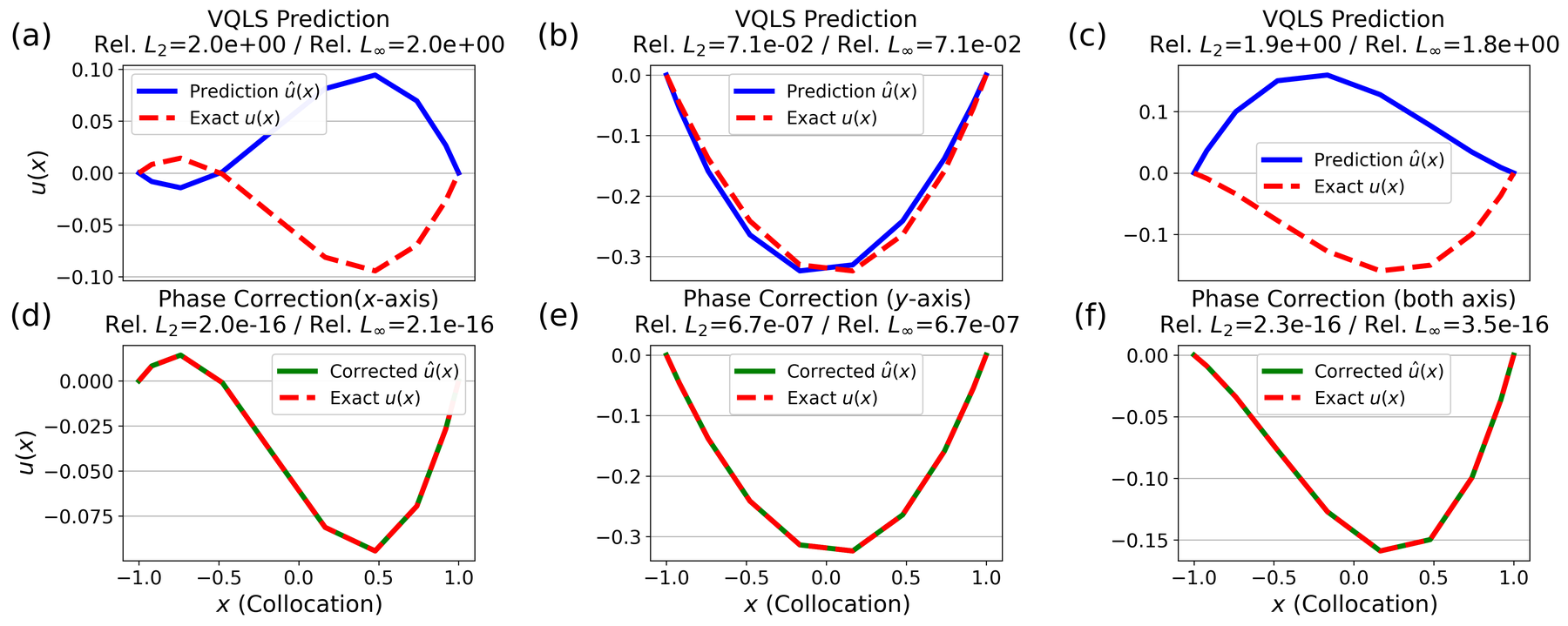
Reflection errors of standard VQLS and their phase correction.
Reflection errors of standard VQLS and the effect of phase correction. (a–c) VQLS predictions with reflection errors along the $x$-axis, the $y$-axis, and both axes; (d–f) the corresponding solutions after phase correction.

Neural embedding for multiple instances

VQLS must be re-optimized for every new PDE instance. NVQLS introduces a classical angle network $g$ that maps each PDE input (forcing functions and coefficients) to circuit parameters, $|\hat{\alpha}\rangle = V\!\left(g(f^{(i)};w)\right)|0\rangle$, so a single model learns the solution operator across instances. The network output has dimension $\mathcal{O}(n^2)=\mathcal{O}((\log N^d)^2)$ for $n$ qubits.

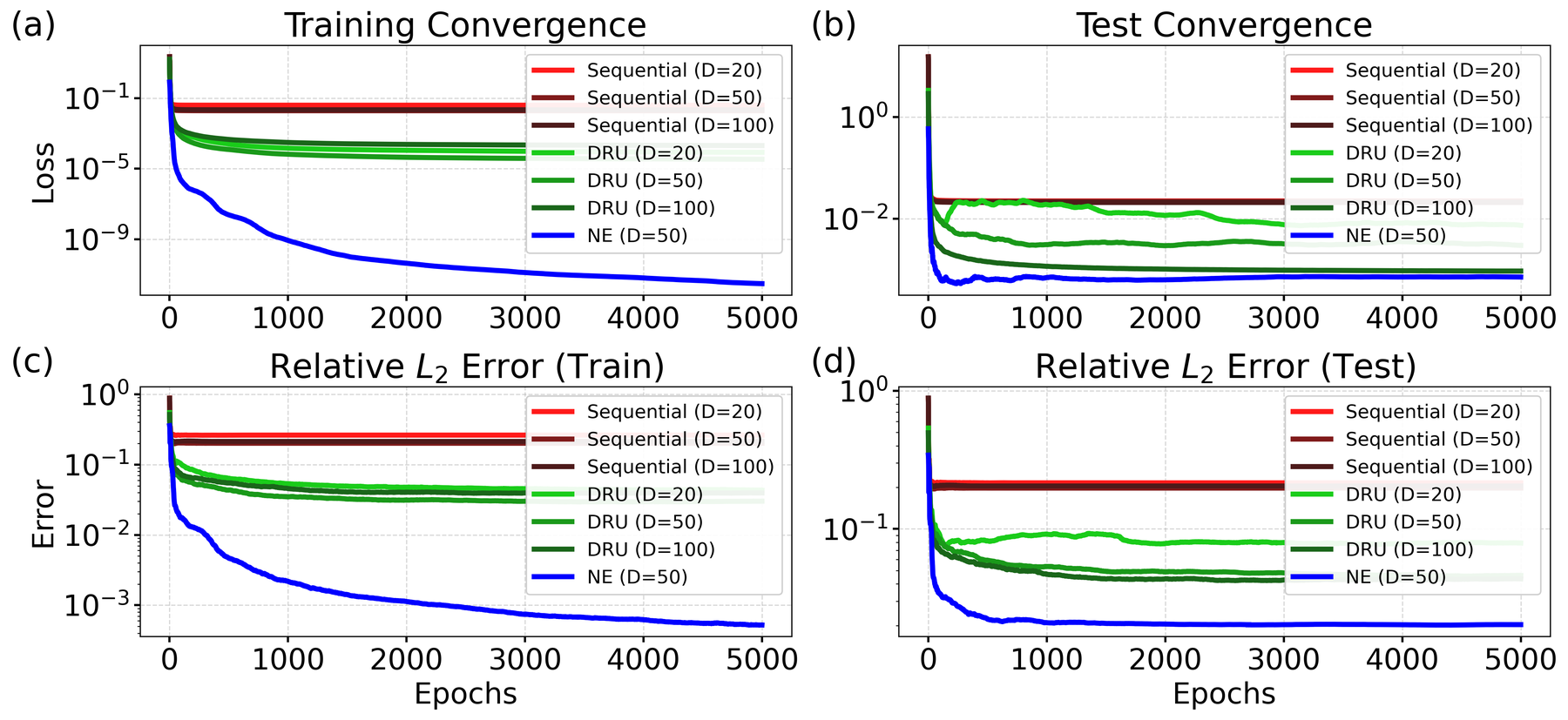
Ablation study on neural embedding.
Ablation on neural embedding (NE). NVQLS with NE (7,780 parameters, depth 10, $D=50$) is compared with sequential and data re-uploading (DRU) embeddings (about 1,200 parameters, depth 100, $D\in\{20,50,100\}$), where $D$ is the number of training instances. Neural embedding enables multi-instance learning with a much shallower circuit.

Conditional Complexity

ModelPer-step computational costClassical working memory
NVQLS $\mathcal{O}\!\left(DN^d(\log_2 N^d)^4/\epsilon^2+DN^d(\log_2 N^d)^2\right)$ $\mathcal{O}\!\left(N^d(\log_2 N^d)^2\right)$
VQLS $\mathcal{O}\!\left(DN^{2d}(\log_2 N^d)^5/\epsilon^2\right)$ $\mathcal{O}\!\left((\log_2 N^d)^2\right)$
SCLON / PI-DON $\mathcal{O}\!\left(DN^{2d}\right)$ $\mathcal{O}\!\left(N^{2d}\right)$

Conditional per-step cost for $D$ PDE instances and peak classical working memory. $N$ is the number of basis functions per dimension, $d$ the dimension, and $\epsilon$ the error tolerance.

The estimates rely on three scaling assumptions: an ansatz whose depth grows linearly with $n$ and that uses $\mathcal{O}(n^2)$ gate parameters is sufficiently expressive; forcing vectors can be prepared with a shallow embedding circuit of depth $\mathcal{O}(\log_2 N^d)$; and $\mathcal{O}(N^d\log_2 N^d)$ grouped measurement settings suffice per loss evaluation. These are supported by observations for the PDEs studied here, but are not guaranteed for general PDEs. The estimates are a methodological result and do not constitute evidence of quantum advantage.

Results

Comparison with SCLON on 1D PDEs

Model RD ($\epsilon=0.1$) Helmholtz ($k^2=4.7$) CD ($\epsilon=0.1$)
Rel. $L_2$Rel. $L_\infty$ Rel. $L_2$Rel. $L_\infty$ Rel. $L_2$Rel. $L_\infty$
NVQLS (Ours) 1.9e-42.0e-4 2.5e-32.5e-3 1.0e-31.1e-3
SCLON 4.8e-35.5e-3 7.3e-37.6e-3 1.3e-31.4e-3

Reaction–diffusion (RD) and convection–diffusion (CD) equations under homogeneous Dirichlet boundary conditions, and the Helmholtz equation under homogeneous Neumann boundary conditions. Each entry is the mean error over 200 test samples.

Comparison with PI-DON on the wave equation

Wave equation results of NVQLS and PI-DON.
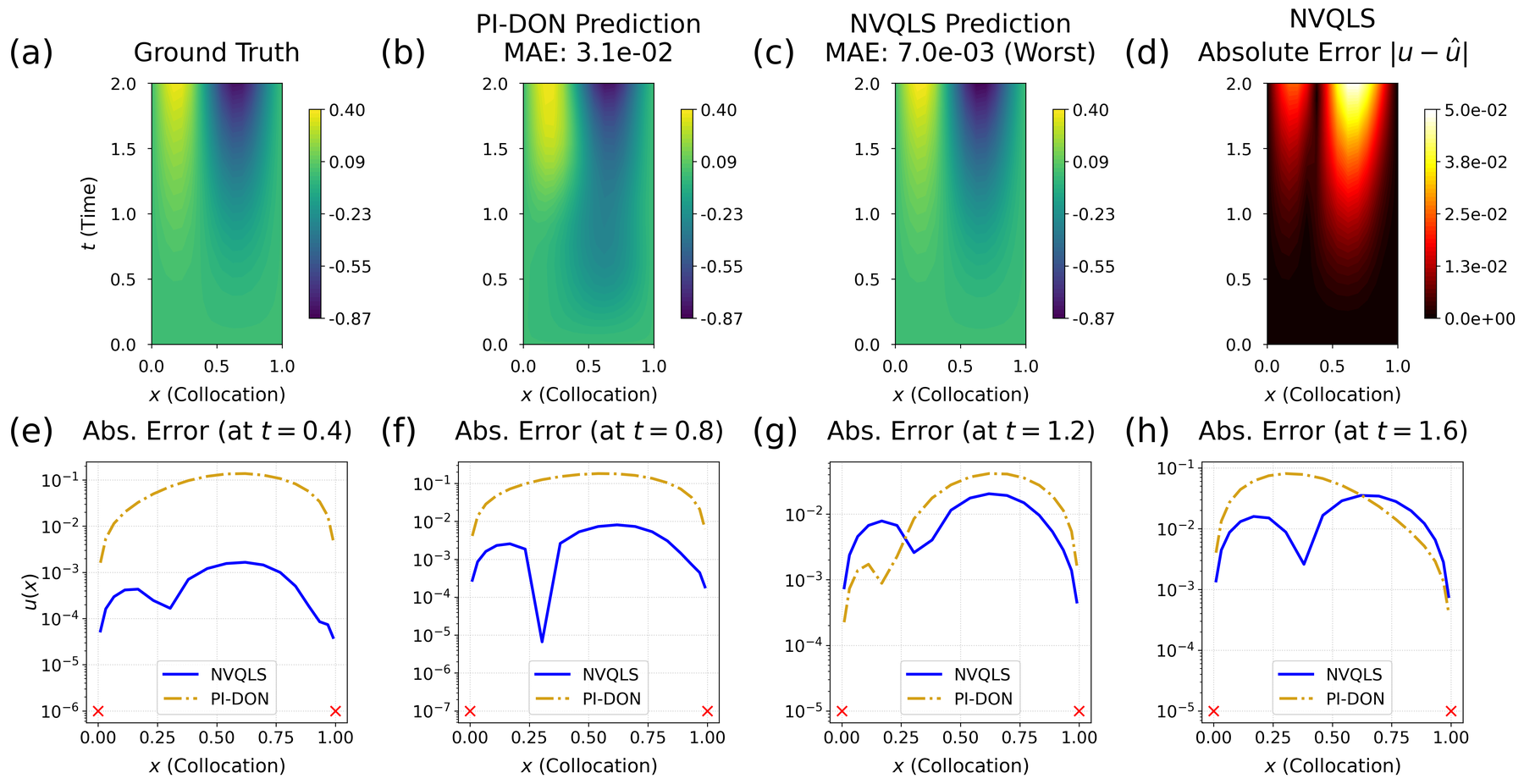
1D wave equation. Row 1: (a) ground truth, (b) PI-DON prediction, (c) NVQLS prediction, and (d) absolute error of NVQLS. Row 2: (e–h) absolute errors of each model at $t=0.4, 0.8, 1.2$, and $1.6$. Across 200 test samples, even the worst-case NVQLS prediction is more accurate than the PI-DON prediction.

Comparison with FNO under limited labeled data

Metric NVQLS (Ours, $D=0$) FNO ($D=50$) FNO ($D=100$) FNO ($D=200$)
Rel. $L_2$ error2.26e-23.54e-22.14e-21.30e-2
Rel. $L_\infty$ error1.40e-23.98e-22.30e-21.42e-2

Wave equation with homogeneous Dirichlet boundary conditions. $D$ is the number of paired input–solution training data. All models are trained for 5,000 epochs, and the minimum test errors on 200 unseen samples are reported. NVQLS uses no labeled solutions.

Beyond 1D

NVQLS results on two-dimensional PDEs.
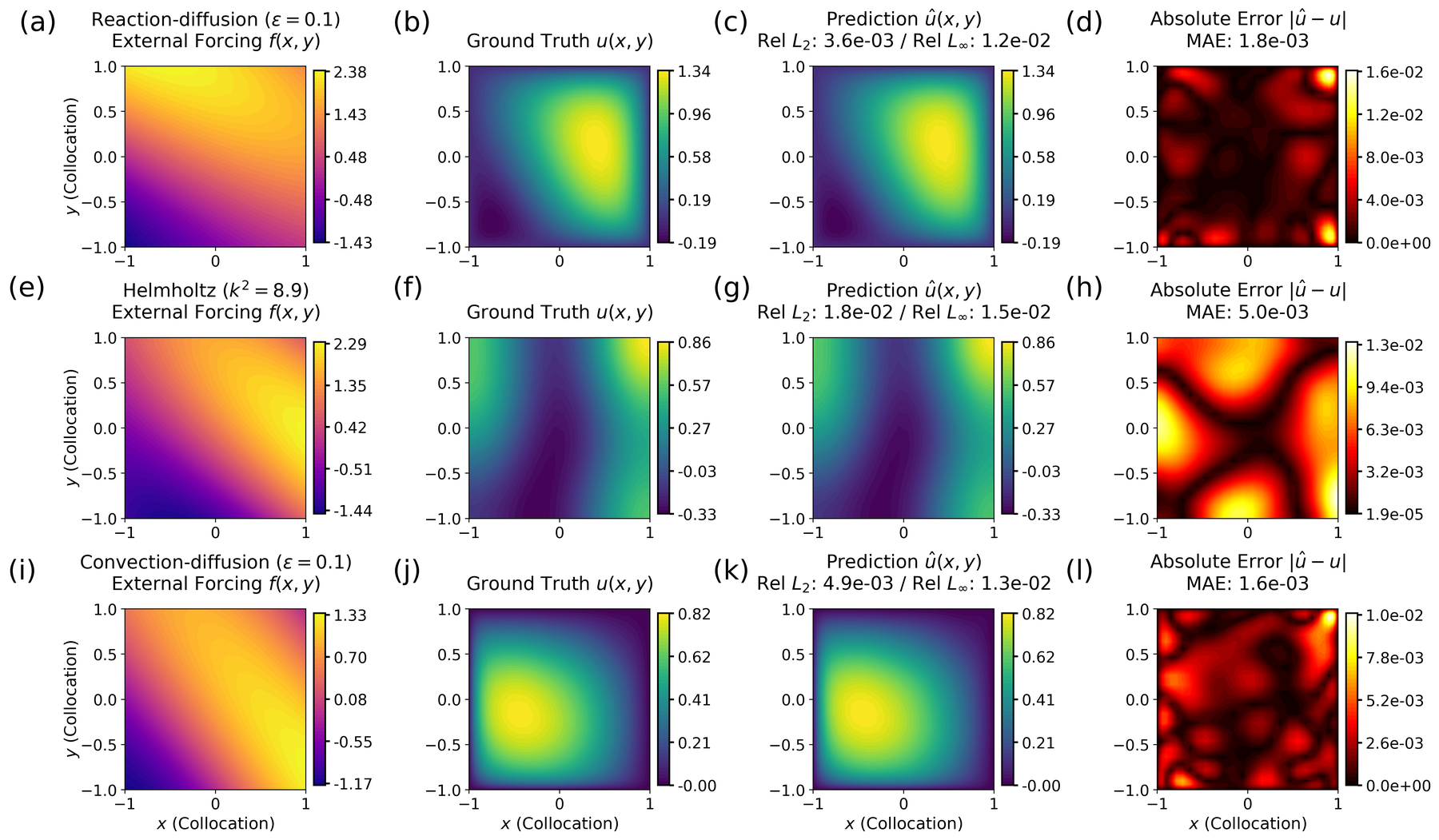
Two-dimensional PDEs. Columns: forcing $f$, exact solution $u$, NVQLS prediction $\hat{u}$, and absolute error $|\hat{u}-u|$. Rows: (a–d) reaction–diffusion ($\epsilon=0.1$, Dirichlet), (e–h) Helmholtz ($k^2=8.9$, Neumann), and (i–l) convection–diffusion ($\epsilon=0.1$, Dirichlet).
  • 2D PDEs: mean relative $L_2$ errors of $3.8\times10^{-3}$ (RD), $2.1\times10^{-2}$ (Helmholtz), and $6.6\times10^{-3}$ (CD); $3.0\times10^{-3}$ with jointly varying coefficient–forcing inputs.
  • 3D elliptic PDEs: mean relative $L_2$ errors of $1.0$–$1.7\times10^{-2}$.
  • Discontinuous variable coefficients: $5.0\times10^{-4}$ for Darcy flow and $8.1\times10^{-3}$ for parabolic diffusion.

Limitations

Our experiments are small-scale noiseless classical simulations, so they validate the framework and its improved scaling under the stated assumptions rather than demonstrate a practical quantum advantage. In hardware-inspired noisy training on the 1D Helmholtz equation, the test relative $L_2$ error rises from $2.44\times10^{-3}$ (noiseless) to $2.68\times10^{-1}$ at device-informed error rates, and to $2.79\times10^{-2}$ at substantially reduced rates. Reducing circuit depth and error accumulation is an important direction for running NVQLS on quantum hardware.

BibTeX

@inproceedings{
kim2026neural,
title={Neural Quantum Spectral Operator Learning for Solving Partial Differential Equations},
author={Chanyoung Kim and Myeonghwan Seong and Kim Yujin and Daniel K. Park and Youngjoon Hong},
booktitle={The Fortieth Annual Conference on Neural Information Processing Systems},
year={2026},
url={https://openreview.net/forum?id=U8esdofq2w}
}